
Category: Education
Teaching Accent Softening and Elocution in the Arab World
First of all, the so-called Arab spring and subsequent chaos in many Arab countries have significantly narrowed the choice of places for a student from the West to learn and practice Arabic abroad. Nevertheless, Jordan, Lebanon, Morocco and Oman – countries who remained largely unscathed by the revolts and anarchy – still offer a number of decent institutions to learn and practice Arabic. Characteristically, the Gulf countries as places of teaching Arabic for foreign students were conspicuous by their absence on the map published by Saudi Al-Arabiya TV channel several years ago[1]. It is, indeed, very much true today as an attempt to learn Arabic in, for example, the UAE would be a pure waste of time and (much) money.
Secondly, even well-established institutions in the Arab world do not offer special courses for elocution and accent softening[2]. It is quite strange for a non-native speaker from, for example, the UK where the accent softening classes are offered throughout the country and shelves of books have been published on this topic. On the other hand, the accent reduction, phonetics and elocution in Arabic are generally absent in the curricula of the universities where Arabic is taught in the Western countries. Obviously, there is a clear need for such a training both in the West and in the Arab countries.
The situation with the textbooks on this topic is no better. So far, I have not come across of any specific textbook which would provide a concise plan how to soften/eliminate the accent and improve the pronunciation. There is, however, a significant number of books which tackle the theoretical aspects of Arabic phonetics[3] while offering no practical advice and exercises.
As I have been learning Arabic for 9 years, first in the university in Germany and then in a number of teaching institutions in Morocco, Egypt and Jordan, I have encountered a total understanding for the need of special courses in Arabic phonetics. As one teacher put it recently “We need it badly and to be honest with you, I have this idea in mind all the time. The problem is with textbooks and expertise” – which was very much to the point.
[2] The only exception is, to my knowledge, Al-Jazeera Media Training and Development Center in Doha which offers a 5-day course for TV and radio presenters entitled “Skills of Voice Placement & Elocution”. Unfortunately, it is not a pure accent softening course for non-native speakers. In addition, the fees of $2000 are hardly affordable for an average student
[3] For example, “Phonetics” (علم الاصوات)by Doctor Kamal Bashar (بشر كمال)
Spectacular Facilities and Stunning Buildings Are Not Enough – The Low Ranking of Arab Universities
With high school exam results out in many countries, I was contacted by friends seeking advice regarding which universities I can recommend to send their family members. With background working in academia I kept a close eye on developments in the higher education system worldwide, and often follow the diverse rankings published annually by magazines, newspapers, websites, institutions, governments, or academics ranking entire establishments globally, regionally or nationally, as well as more detailed rankings listing programs, departments or schools.
Taking a look at the latest lists from different sources, I felt sad how low Arab Universities are ranked. I find it painful that despite the vast sums of money Arab countries spend on the sector, and the expanding campuses occupying hundreds of acres, and hosting splendid infrastructure, exquisite buildings and state of the art technology, the research outcome and the teaching quality leave a lot to be desired.
In the table below I summarise the results I obtained from the major higher education ranking sources, and compare the Arab world’s results with those for institutions in Singapore (a country with approximately 10% and 1.5% of the Arab world’s GDP and population respectively). I also compare the results with the rankings for institutions in Israel, a country Arabs like to bench themselves against.
Table 1: Highest ranking university in the Arab world, Singapore and Isreal
|
Country /Region |
Rankings |
||
| QS University | Times Higher Education |
Shanghai |
|
| Arab world |
173 |
201-250 | 101-150 |
| Singapore |
11 |
24 |
91 |
|
Israel |
145 | 186 |
93 |
In the graph below, a normalised score is shown comparing the scores of the Arab world to those in ASEAN or the trio of Taiwan/Hong Kong/Macau, and to Israel.
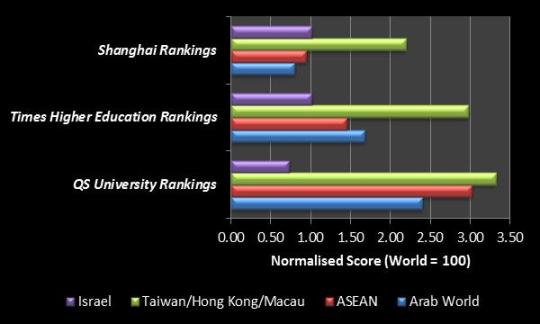
Figure 1: Normalised ranking score in several regions/countries
The results above are a snapshot, and I have no judgment on which ranking is the better list or the pros and cons of any of the rankings or their methodologies.
I write this not as a form of self-abasement, pity, or disrespect, but rather as a wake-up call hoping that some egos will be stimulated to wipe out the shameful results and act to rectify the situation. I live in hope.
 Factelligent